Browsed by
Tag: gst impact

GST: IT backbone GSTN allays concerns of data mix-up on GST portal

GST: IT backbone GSTN allays concerns of data mix-up on GST portal

GST India

GST Network today allayed concerns of mixing up of taxpayers’ data on the portal, saying enough protection has been taken to guard against any overlapping.

The Mumbai division of the Central Board of Excise and Customs (CBEC) had received complaints from certain taxpayers that the GST portal is mixing up their data with others.

GST Network (GSTN), which provides technology backbone for the new indirect tax regime, said instances of one taxpayer’s information being shown to another have happened only at the level of individual tax consultants and not the GST portal.

“There is not even the slightest possibility of data on the GST portal being mixed up. Taxpayers can file their tax invoices, returns and other details in complete confidence and without fear of their data being shown to anyone else,” GSTN Chairman Navin Kumar said.

In a statement, GSTN said tax consultants work on activation and migration of provisional IDs of several of their clients simultaneously by opening several windows on the same browser and the information gets stored in the cache of the computer.

“Thus, when the multiple provisional IDs are being created by the tax consultants, the common form is getting mapped to last provisional ID that was activated, resulting in showing wrong data being posted against a particular provisional ID,” it said.

Hence, this is not a problem with the robust GST system, but only at the level of data entry at the taxpayer’s side, GSTN asserted.


XaTTaX GST e-filing software – Simple, Secure, Reliable

The IT backbone of the GST portal is extremely sound and can handle large amounts of data without any possibility of data overlap. The portal can handle as many as 3 billion transactions every month, it added.

Certain taxpayers had complained that when they were logging into their accounts, they were diverted to some other account on the GST portal and the data of another taxpayer was being displayed.

The CBEC has asked tax consultants not to open more than one enrolment or registration case at one time.

“After completing one case, clear the cache memory of the computer system before initiating second registration/ enrolment process,” CBEC had said.

Meanwhile, GSTN is organising a webinar on ‘Composition Levy Scheme in Goods and Service Tax’ tomorrow to answer taxpayers’ questions on features, rate of tax of the composition levy, eligibility criterion and relevant conditions, among other things.

The participants will have to register on NeGD (National E Governance Division) portal.


GST Ready Software – For Small And Medium Business

Source: Business Today

GST to be positive for auto, retail sector; negative for SMEs: Fitch

GST to be positive for auto, retail sector; negative for SMEs: Fitch

GST: Fitch-Ratings

New indirect tax regime Goods and Services Tax (GST) is likely to be beneficial for auto, cement and organised retail sectors, but will have a negative impact on oil and gas, and SME sectors, Fitch Ratings said today.

In contrast, the impact would be broadly neutral for property, electricity, telecom, pharmaceutical and fertiliser sectors, it said.

“The national service tax (GST), is unlikely to lead to rating changes for any of Fitch’s internationally rated corporates despite being negative for certain sectors,” it said.

However, implementation risks will remain over the next 12 months due to the complexities of adopting the new system amid a culture of poor compliance, particularly among the traditional retail and SME sectors.


GST Ready Software – For Small And Medium Business

Implemented on July 1, Goods and Services Tax (GST) replaces over 17 different taxes, including excise, service tax and VAT.

“A number of near-term challenges for the larger corporates are likely to persist until all trading counter parties are on the system and familiar with the different tax rates that will apply to their goods and services,” Fitch said.

Under the GST regime, a corporate will only be able to apply GST input tax credits after its supplier of goods or services has first settled its GST payment with the government. This means that the burden of non-compliance by the supplier will rest with the purchaser and not the government, the US-based agency said.

“Accordingly, GST tax truancy by financially weak and non-compliant companies lower down the supply chain could limit the amount of input tax credits available for the larger and financially strong corporates,” Fitch said.


Ease Your GST Filing & Invoice – with XaTTaX GST Software

Source: India Today
GST impact on cigarettes: Council hikes cess after surprise windfall gains

GST impact on cigarettes: Council hikes cess after surprise windfall gains

GST Impact :cigarettes

The Goods and Services (GST) Tax Council on Monday increased the cess on cigarettes to correct the unintended outcome of a reduced tax incidence on the demerit good after the roll-out of the new tax. Apart from the highest GST rate of 28%, the cess on cigarettes will now be higher by Rs 485-792 per thousand sticks for different varieties of the commodity. “While any reduction in tax incidence on items of mass consumption would be welcome, the same would be unacceptable in case of demerit goods like cigarettes,” the government said in a statement.

Meanwhile, the council reckoned that new registrations on the GST Network (GSTN), the IT backbone of the system, have been more than expected. Nearly 7.4 lakh new businesses have registered for GST since June 25 when the registration for new taxpayers was opened.


XaTTaX GST e-filing software – Simple, Secure, Reliable

According a study conducted by GSTN, it was estimated that around 4-5 lakh new businesses would register with the system but the near doubling of that number has come as pleasant surprise to the government. GSTN had estimated that growth in the taxpayer base would be 4-5% on an annual basis.

With migration of over 70 lakh existing taxpayers into the GST system and another 7.4 lakh new taxpayers, the total GST taxpayer base is numerically close to the previous Centre-state indirect tax assessee base of 80 lakh. Finance minister Arun Jaitley noted that the taxpayer base must have actually expanded already as a section of taxpayers used to register separately for excise/service tax and VAT in the previous regime.

“With VAT and service tax registrations base of 80 lakh, we had estimated that not more than 4-5 lakh new taxpayers would register, but the numbers prove that businesses have welcomed GST,” GSTN chairman Navin Kumar told FE. He added that while the tax department could better analyse the spurt in numbers, it was possible that businesses realised it would be difficult to carry out trade from outside the ambit of GST.

Moreover, this number could jump further as nearly 35,000 new businesses are registering daily. This daily registration rate has not dwindled since June 25, when the window for new businesses to register was opened. In comparison, the daily migration figure for existing taxpayers had come down to 12,000 from 35,000 since June 25. Over 70 lakh existing taxpayers have migrated to GSTN till July 17 after the the migration window opened again on June 25.

GST : Conrner imageHowever, just 90,000 businesses opted for the composition scheme so far. Kumar said that it was perhaps because the stringent eligibility criteria, which allows only those with intrastate supplies to register, may have played a part in the lukewarm response. Registration to the composition scheme is available to those with less than Rs 75 lakh per annum revenue, and is restricted to manufacturers and traders.

The window for the scheme will close by July 22 and the chairman urged the businesses to register for the scheme as early as possible as the next chance for the same would be available only next year.


Ease Your GST Filing & Invoice – with XaTTaX GST Software


Source: Financial Express
GST impact on companies: What it’ll take for companies to reap gains

GST impact on companies: What it’ll take for companies to reap gains

Indian GSTThe Goods and Services Tax , a radical step towards the country’s transformation into a common market, became a reality at the stroke of midnight on July 1, 2017, and its implication on the industry extends well beyond tax. GST affects every part of the business, right from financial reporting and tax accounting to supply chain, technology enablement and contracts redesign.

The need of the hour is to ensure that the GST registration process is complete and the IT, billing and enterprise resource planning (ERPs) are suitably rejigged to fulfil statutory obligations.

The first key action point is to update the customer and vendor masters. This requires collection of information in terms of the GST Identification Number (GSTIN) of suppliers and vendors, determining the  Harmonized System of Nomenclature (HSN)/ Service Accounting Codes (SAC) of goods/services to be supplied and their applicable GST rates. Second, all the existing documents, such as tax invoices, credit/debit notes, delivery challan, which are to be issued under the GST regime, need to be modified to capture additional information required under Goods and Services Tax .

There is a requirement for issuing certain other documents, such as payment vouchers at the time of making payment to vendors for supplies on which tax is payable under reverse charge, receipt and refund vouchers related to advances and a self-invoice in case of procurement from unregistered dealers. All these documents need to be incorporated in the IT system. Further, all internal reports and periodical MIS reports also need to re-aligned from GST perspective.

Another significant requirement in terms of GST is payment of taxes on advances. The law requires that GST is to be paid in the month in which advance has been received, but the same can’t be adjusted either fully or partly at the end of the month. Goods and Services Tax  is payable only on the amount of advance which is pending at the month end. In such cases, though the tax is paid on advances, the tax invoice will be issued only when the goods are being supplied. Customers can get the credit only when the goods are received by them. There are separate reporting requirements under GST for taxes paid on advances and their adjustment. IT systems should be able to track down the month-end advances on which GST is to be paid and their adjustments made in subsequent months.

The readiness of internal IT system is one of the key requirements for successfully continuing the business with minimum glitches. Further, eligibility of input tax credits are dependent upon the electronic reconciliation of the sales information uploaded by vendors and purchase information uploaded by the recipient on the GSTIN system. This creates a significant onus to correctly upload the sales and purchase data in order to ensure electronic reconciliation between the information uploaded by vendors and customers. Further, each assessee will be able to download the information uploaded by her/its suppliers and reconcile the same with the information uploaded by them.


XatTaX: India’s most trusted GST compliance software – 100% accurate GST filing

For filing the GST returns, assesses will have to access the Goods and Service Tax Network (GSTN) portal and upload the information in requisite formats. GSTN has appointed GST Suvidha Providers (GSPs) who would assist in filing of returns as IT conduits. In order to work with GSPs, there is a requirement of Application Service Providers (ASPs) solution. Some GSPs have developed their own ASP solution to provide an end-to-end solution to assesses.

ASPs will focus on taking taxpayers’ raw data on sales and purchases and converting it into GST returns (in case of multiple registrations, it is a huge task manually). These GST returns, or GSTRs, will then be filed on behalf of the assessee with GSTN via the GSP network.

GSP provides a secured tunnel which feeds in data from ASP (in other words, ASP’s output becomes input for GSP) to the GSTN and generates an acknowledgement.

Companies dealing with a large number of invoices every month need to automate and upgrade their ERP software to provide data points on a timely basis to cope with the increased number of returns. A good ASP-GSP is required to make the process of reconciliation under the GST regime seamless and hassle-free.

Relooking the manpower requirement to carry out the tax compliances is another area which needs consideration by organisations. Companies have to rethink their organisation structure for GST compliance, as to whether they can undertake all compliances at a central level as much of the work is online or if they still need to work at a decentralised level as in the pre-GST regime.

Goods and Services Tax  calls for a behavioural, infrastructural and technological change among enterprises so that they can reap the potential gains of its implementation. In this context, information technology/ERP software are going to play a pivotal role.


XaTTaX: Cloud and On-Premiss Based GST Filing Software For India

Source: Financial Express
GST impact on common man: New tax regime will deliver a mixed bag with some items turning costly

GST impact on common man: New tax regime will deliver a mixed bag with some items turning costly

GST Impact

History was created on July 1, 2017, when the country witnessed the biggest indirect tax reform, Goods and Services Tax (GST) come into existence, after a topsy-turvy journey of over 10 years. GST is not just a tax reform, but a reform for Indian business that will change the way businesses were done in the country so far. While some companies are still struggling to gear-up their ERP systems to make them tax compliant, some have already announced a price-drop on their products and services. As far as the common man is concerned, GST will have a far-reaching impact on the prices paid for goods and services that are consumed on a day-to-day basis. Let us try to understand what GST is all about, and how it is going to impact the common man.
GST is a destination-based tax, applicable on supply of all goods and services. India has adopted a dual GST model which has two components namely state GST (SGST) and central GST (CGST). Any supply of goods or service within a particular state will attract both SGST and CGST, whereas, any supply of goods or service from one state to another will attract integrated GST (IGST) which is the summation of both SGST and CGST.

Goods and Services Tax provides for a four-tier rate structure for both goods and services, and seamless flow of tax-credits across goods and services. GST seems to be a mixed bag for the common man, with some necessities becoming cheaper and others likely to get slightly expensive. In the long run, GST will ultimately result in reduction of prices and have a favourable effect on most of the sectors, but on the basis of the experience in other countries, GST may result in an initial inflationary impact which will pinch the common man’s pocket for some time.
In order to understand the impact on the common man, let us categorise daily expenses into six buckets:

Food: Eating out or cooking at home has become relatively cheaper with reduction in tax rates on essential items and removal of cascading effect of tax on eateries and restaurant. For instance, most of the food items such as sugar, tea, edible oil, food grains, etc, will be charged a lower rate, of 5%. Essential items such as milk, curd, cereals, rice (unbranded) have been exempted from levy of GST. Today, eating out at a restaurant, a consumer pays both service tax and VAT on the invoice, apart from service charge collected additionally. Under Goods and Services Tax, the rate of tax on the restaurant invoice could be either 5%, 12% or 18%, depending on whether the restaurant is under the composition scheme, non-air conditioned or air-conditioned, respectively.
Housing: Buying a new house under the GST regime is going to cost slightly higher in the short run. For under-construction property, the existing tax rates are broadly around 6% in most states, comprising service tax and VAT (other than a few where the VAT rate is higher). Under Goods and Services Tax, the rate shall increase to 12%, with the ability of the builder to avail all input tax credits resulting in a reduction of his costs which may be passed on to buyers by commensurate reduction in prices. However, this may not be possible for the builder immediately, especially where the builder has already procured the construction material.
Transportation: Buying cars will burn smaller holes in customer’s pocket under GST regime as compared to erstwhile regime. Key market players have already announced price-cuts owing to benefit on account of increased credits and marginal reduction in tax rates. Also, travel in radio taxis will cost less, with the GST rate applicable being 5% as against 6% under the erstwhile regime.
Entertainment: GST is a boom for all who like to spend weekend outdoors, as effective from July 1, going to the movies will be more economical with entertainment tax —that was as high as 50% in some states—subsumed under GST.
Communication: However, GST may not be good news for people who like spending time on their handsets as it is going to pinch the pockets with the rate on most services including communication going up by 3%, from a 15% service tax to 18% GST.
Other daily household items: FMCG goods will witness a mixed impact under the GST regime. On the one hand, aerated drinks purchased from nearby shops will become more expensive, with the GST rate applicable being 28%, along with a 12% additional cess. Personal care products such as soaps, kajal, tooth-paste and hair oil will see a drop of almost 10% in the effective tax rate applicable.

To sum-up, GST delivers about a mixed bag to the common man. To ensure that industry does not increase the prices of their goods and services even if the tax rates are marginally going up, the government has incorporated an anti-profiteering clause in the law which mandates that the supplier pass on all benefits received either on account of reduced tax rates or increased credits to consumers by way of reduced prices.
Goods and Services Tax is no-doubt a win-win situation, from India’s economic standpoint—it will place the country in the list of nations which have simplified tax regimes, thereby attracting foreign investments, as well as from the common man’s perspective with prices of products and services coming down in the long run. It will be interesting to see as to how the government manages to deliver on its promise of holistic economic growth and reduced inflation in the long run, courtesy of the ‘one nation, one tax’ regime.

Source: Financial Express
GST impact: Companies face jail term for not reprinting revised MRP on inventory

GST impact: Companies face jail term for not reprinting revised MRP on inventory

GST:Ram Vilas Paswan

Consumer Affairs Minister Ram Vilas Paswan today warned of a fine of up to Rs 1 lakh, including a jail term, if new post GST rates are not printed on the inventory in the interest of consumers.

Manufacturers have been allowed to clear the unsold stocks by September with new MRP.

A committee of the consumer affairs ministry has been set up to address consumer grievances on GST and even helplines have been increased to 60 from 14 to address tax related queries, he said.

More than 700 queries have been received by the consumer helplines and the ministry has sought expert help from its finance counterpart to resolve them.


GST Compliance – Register Now To Get Free Demo

“There are initial hiccups while implementing GST, but all those will be resolved soon. All ministries concerned, including finance and consumer affairs, are alert and a redressal mechanism is in place to resolve the concerns of consumers and traders,” Paswan told reporters here.

Under the GST regime, he said some prices of goods have fallen and some have risen.

“We have told companies to reprint revised rates on unsold goods. Stickers of new MRP should be pasted so that consumers are aware of the change in rates after GST,” he said.

It is mandatory to print revised MRP on the inventory, else stringent action will be taken for violation of the Packaged Commodities Rules, he warned.

Non-compliance of this will attract a fine of Rs 25,000 for first time offence, Rs 50,000 for second time and up to Rs 1 lakh penalty for third offence onwards and even imprisonment of up to one year, he told PTI separately.

India moved to the Goods and Services Tax (GST) on July 1. A relaxation was given to manufacturers and importers to reprint the new maximum retail price (MRP) after GST on the inventory to be sold by September.

Paswan also said the new rates to be printed on the inventory should be communicated to the consumer affairs ministry and advertised for better awareness of consumers.

Source :  Business Standard
GST impact: As car prices fall by way of up to Rs 3 lakh, check out which all grew to become inexpensive

GST impact: As car prices fall by way of up to Rs 3 lakh, check out which all grew to become inexpensive

GST Impact : car prices

Auto companies are adjusting the prices of their products after the government rolled out goods and services tax (GST) on 1 July.

Under the GST rates, cars will attract the top rate of 28 percent with a cess in the range of 1 to 15 percent on top of it.

While small petrol cars with engine less than 1,200 cc will attract 1 percent cess, that with a diesel engine of less than 1,500 cc will attract 3 percent cess.

Large cars with engine greater than 1,500 cc and SUVs with length more than 4 metres and engine greater than 1,500 cc will attract cess of 15 percent over and above peak rate of 28 percent.

Hybrid vehicles will also fall in the category under GST. In comparison, tax on electric vehicles has been kept at 12 percent. At present hybrid vehicles attract excise duty of 12.5 percent, similar to the ones on entry level small cars such as Tata Nano or Maruti Alto.

Earlier, the tax incidence on cars ranged between 28 percent and 45 percent. Under GST, the maximum rate is 43 percent.

Here’s how companies are reacting to the GST rollout:

Maruti Suzuki

The country’s top automaker Maruti Suzuki India (MSI) cut prices of most of its models by up to 3 percent. It has cut the price of the Alto in the range of Rs 2,300 to Rs 5,400, the WagonRRs 5,300-Rs 8,300 and that of the Swift between Rs 6,700 and Rs 10,700.

It has also reduced the price of the Baleno in the range of Rs 6,600 and Rs 13,100 and that of the Dzire ranging between Rs 8,100 and Rs 15,100.

Representational image. Reuters

Price of Ertiga petrol has been cut by up to Rs 21,800 while that of petrol powered Ciaz by up to Rs 23,400. The SUV Vitara Brezza has become cheaper by Rs 10,400-14,700, while the S-crossby Rs 17,700-21,300.

However, the Ciaz and Ertiga models with smart hybrid technology have become costlier due to withdrawal of tax concessions on mild hybrid vehicles under the GST. Diesel versions of the sedan Ciaz and MPV Ertiga with mild hybrid technology saw prices increase by over Rs 1 lakh.

XaTTaX: Cloud and On-Premiss Based GST Filing Software For India‎‎‎

Toyota Kirloskar Motor

The company cut prices ranging between Rs 10,500 and Rs 2.17 lakh (ex-showroom Bengaluru).

It has reduced prices of all new Fortuner by up to Rs 2.17 lakh, Innova Crysta by up to Rs 98,500 and Corolla Altis by up to Rs 92,500, Platinum Etios by Rs 24,500 and that of Etios Liva by up to Rs 10,500.

However, the prices of hybrid variants Toyota Camry and Toyota Prius increased by Rs 3.5 lakh in Bengaluru and up to Rs 5.24 lakhs in Delhi as per applicable tax under GST.

Honda Cars India

The company cut the prices of its models by up to Rs 1.31 lakh.

The company has cut price of its hatchback Brio by up to Rs 12,279 and that of the compact sedan Amaze by up to Rs 14,825. It has slashed price of the Jazz by up to Rs 10,031 and that of its recently launched model WR-V by up to Rs 10,064.

The mid-sized sedan City has seen a reduction in the range of Rs 16,510 and Rs 28,005. The BR-V prices will come down by up to Rs 30,387.

The premium SUV CR-V has also seen a price drop of up to Rs 1,31,663.

Honda is yet to decide on the revised pricing of Accord Hybrid. The revised prices are for ex-showroom Delhi and will vary from state to state.

Ford

The company has cut the prices by up to 4.5 percent. The steepest cut will be in Mumbai with the company’s flagship SUV Endeavour becoming cheaper by up to Rs 3 lakh.

In Delhi, the price of Figo has been cut by Rs 2,000, that of the compact SUV Ecosport by up to Rs 8,000, and the SUV Endeavour by up to Rs 1.5 lakh.

In Mumbai, the prices will go down in the range of Rs 28,000 on the Figo to Rs 3 lakh on the Endeavour.

TVS Motor

The two-wheeler major TVS Motor Company has reduced prices of its models by up to Rs 4,150 to hand down GST benefit to customers.

Honda Motorcycle and Scooter India

The company has slashed prices of its products by up to Rs 5,500 depending on model and state

Hero MotoCorp

The company has cut prices by up to Rs 1,800. The company sells a range of bikes priced between Rs 40,000 and Rs 1.1 lakh. It said, in one or two states, such as Haryana, where the pre-GST rates were lower than the post-GST rate, the prices of a few models may go up marginally.

BMW

The German luxury car maker cut prices ranging from Rs 70,000 on base end version of X1 to Rs 1.8 lakh on the top end of its sedan 7 series.

However, the hybrid model i8 will witnessed a hike of Rs 4.8 lakh to Rs 2.28 crore.

Jaguar Land Rover

The Tata Motors-owned company has reduced prices of its entire vehicle range in India on an average by 7 percent.

The Jaguar portfolio in India includes XE with a starting price of Rs 34.64 lakh, XF starting at Rs 44.89 lakh, F-PACE Rs 67.37 lakh onward and XJ with a starting point of Rs 97.39 lakh (ex-showroom prices across India).

On the other hand, the Land Rover range includes the Discovery Sport starting at Rs 40.04 lakh, Range Rover Evoque at Rs 42.37 lakh upward, Range Rover Sport beginning at Rs 89.44 lakh and Range Rover with a starting price point of Rs 1.59 crore (ex-showroom in India).

Mercedes Benz

The company has cut prices of its vehicles produced in India by up to Rs 7 lakh.

Mercedes Benz India locally produces nine models — CLA sedan, SUVs GLA, GLC, GLE and GLS, luxury sedans C-Class, E- Class, S -Class and Maybach S 500 — which are priced between Rs 32 lakh and Rs 1.87 crore (ex-showroom Delhi).

The price reduction ranges from Rs 1.4 lakh on the CLA sedan to Rs 7 lakh on Maybach S 500. Price reduction varies by state between 2 percent to 9 percent and is dependent on current tax
structure and local body taxes of states, the company said.

Latest Updates on GST – Goods and Services Tax Info‎‎‎


Source: firstpost
GST impact: Insurance premium, bank charges to increase

GST impact: Insurance premium, bank charges to increase

GST Insurance

The impending implementation of GST would undoubtedly impact one’s personal finances especially when it comes to financial services, albeit marginally. From the present rate of 15 percent, the GST on banking, insurance and investments such as real estate, mutual funds will see a hike of 3 percent as the GST will now be 18 percent on them.

Let’s see how each of them gets impacted.

GST and Insurance
Primarily, there are three major kinds of life insurance products – Term insurance plans, Ulips and Endowments (including money back). The applicability of service tax (in the current format) on their premium is not similar in all three of them.

The premium paid in life insurance policies represents two portions – risk coverage and savings. The service tax is only on the risk portion of the premium and not on savings portion.

As per the GST rules, the value of services (on which GST is to be imposed) in relation to life insurance business shall be:

(a) The gross premium reduced by the amount allocated for investment, or savings on behalf of the policy holder.

(b) In case of single premium annuity policies, ten per cent of single premium charged from the policy holder.

(c) In all other cases, 25 per cent of the premium in the first year and 12.5 cent of the premium in subsequent years. So, if the premium of an endowment plan is Rs 100, the GST of 18 percent will be applicable on the 25 percent of the premium i.e.on Rs 25, so, Rs 4.5 will be the GST amount.

(d) If the entire premium paid by the policy holder is only towards the risk cover in life insurance such as in term insurance plans, the GST of 18 percent will be on the entire premium.

Therefore, the immediate impact of GST would be the higher outgo (premium plus GST) in term and endowment plans, due to the increase in rate of tax on insurance following implementation of the GST. “In theory, this could mean an increase of 3% in premium from the existing applicable premium effective from 1st July 2017, across life, health and general insurance, however, some of this should be offset if tax on services availed by the industry are allowed to be taken into account to decrease insurers’ tax paid,” says Mathieu Verillaud, Chief Financial Officer, Bharti AXA General Insurance.

The policyholders may stand to benefit only if the insurance companies are allowed the benefit of input tax credit. “This unfortunately is not clear as of yet given the complexity of the state/centre structure of GST, this might drive some confusion as well as higher compliance and administrative costs for insurers. If these are not passed on to customers, prices might either go up, or stay low but will affect the market’s solvency and financial health,” says Verillaud.

GST impact: Insurance premium, bank charges to increase

Similar will be the impact on general insurance such as car, health and other non-life policies i.e. service tax (when replaced by GST) will increase by 3 percent of the premium amount. This would increase total outgo (premium plus tax).

Impact : The overall impact could be nominal but once implemented, both, existing and new policyholders will have to bear the additional cost.If the current premium of a term plan is Rs 10,000, (excluding the service tax of 15 percent) the GST impact will up the premium including tax by Rs 300 i.e from Rs 11,500 to Rs 11,800. While, comparing premium especially of term plans, make sure you are looking at premiums including or excluding GST for all the insurers. Nothing changes in the selection process as the GST impact will be same across insurers. Stick to a proper selection process while getting the right insurance policy.

GST and real estate
Real estate sector is marred with plethora of taxes both at the state and central level. GST hopefully will put in a more streamlined tax structure in place. “The heavily taxed real estate sector welcomes a single stable 12% GST rate, inclusive of the value of land and with full input tax credits,” says Rajeev Talwar, Chairman, NAREDCO.

But, will the home prices be lower than they are now in the post GST era? “NAREDCO is of the view that the actual tax incidence under GST would match or be lower than the existing multiple indirect taxes on the sector. The GST rate for work contracts which will also be offset by input credits, will provide for a seamless and simplified tax policy”, says Talwar.

However, it seems arriving at a conclusion regarding price impact could be a bit premature. “The GST rate is not the only important factor. The abatement rules as applicable under the service tax regime and the input tax credit facility for developers will determine if the effective tax incidence on real estate is lower or higher under GST,” says Anuj Puri, chairman of JLL Residential.

According to Puri, here’s why it will take time to conclude if the GST is tax neutral or tax adverse for the real state sector, “Effectively, the composition scheme allowing for abatement against cost of land to the extent of 75% of the house cost for residential units priced under Rs 1 crore and less than 2000 sq. ft. makes the effective rate at 3.75%. In other cases, the abatement goes down to 70%, making the effective rate at 4%. This will go a long way in determining whether GST is tax neutral or tax adverse for real estate”.

The situation may not be same in the luxury segment. Surendra Hiranandani, Chairman & MD, House of Hiranandani says, “In the case of a premium development, the entire input tax credit is not sufficient to bring down the fresh tax liability to nil because of the taxes paid on other expenditures, having negligible impact.”

The actual impact may be few months away after the implementation of GST. “More clarity will prevail once the GST gets implemented and the government clears its stand on the abatement available for the land cost for calculating service tax on under-construction projects.” says Hiranandani .

GST and banking

Transaction fees in financial services are likely to increase as the government has put these under the 18% tax bracket in the new GST regime. These services were so far taxed at 15% and the hike in the tax rate means that individuals will have to pay Rs 3 more for every Rs 100 paid as charges/fees for banking transactions. It may be mentioned that recently several banks starting with SBI introduced or increased service charges for multiple banking transactions including cash withdrawals exceeding a certain number of times in a month.

GST and mutual funds
The impact of GST on the returns of mutual funds will be largely marginal. The levy of GST will be on the total expense ratio (TER) of the mutual fund. The TER, commonly known as expense ratio of mutual fund houses, will also go up by 3 per cent. Expense ratio is the measure of the cost incurred by an investment company to operate its mutual fund.

As per the SEBI guidelines, AMC’s can levy charge within the limits prescribed under the regulations. So, if the limit is say, 2.25 percent of total assets under management, the service tax of 15 percent has to be within it.

Impact : Let’s assume the return on equity (market return) is 15 percent when the scheme’s TER is 2.25 (regular scheme) including the service tax.This means, TER without tax is 1.96. Now, to maintain the same TER (as it is capped), at a higher GST rate of 18 percent, the TER has to be lower at 1.91 percent. The AMC’s may have to absorb this marginal difference unless SEBI increases the TER cap.

Conclusion
Even though the hike will be nominal, taken together for all the insurance covers, the increase in the outflow could be something to account for by many policyholders. For someone paying annual premium for car, household, health, term plan, personal accident cover, a total of say Rs 50,000 a year could see a jump in premium outflow by Rs. 1,500 a year, with no additional risk coverage or benefits. The actual impact of GST on financial services including banking, insurance will however, be known only once it gets implemented. As a policyholder and an investor, no change, as of now, is required to be made in advance when it comes to GST.
 Source: ET
How GST impacts FMCG firms

How GST impacts FMCG firms

The new Goods and Services Tax (GST) regime will bring several benefits for the economy, and could particularly vitalise the fast-moving consumer goods (FMCG) industry.

Apart from driving supply chain efficiencies, bringing untaxed players into the tax net—a large section of the industry still operates in the unorganised segment— will level the playing field for the larger, established players in the industry.

However, the GST rate structure shows that not all FMCG companies stand to benefit from the new regime.

Products to be taxed at higher rate

How GST impacts FMCG firms

Source: Axis Capital

GST beneficiaries
The rates for various FMCG segments have mostly been along expected lines. Items of mass consumption—toothpaste, soaps, hair oil—have been put under the 18% tax slab, significantly lower than the 22-24% tax rate they have been paying. This is in accordance with the government’s stance of keeping tax rates low for mass consumption products. In fact, the GST rate schedule indicates that nearly 81% of all items are in the 18% tax bracket or below. The remaining 19% fall in the 28% tax slab.

Products to be taxed at lower rate

How GST impacts FMCG firms

The FMCG companies, whose tax incidence has come down under the GST regime, are likely to pass it on to the consumers in the form of lower prices. “With the anti-profiteering clause in place, companies would be required to pass on the benefit of tax rates to the consumer in the form of lower prices,” says Sanjay Manyal, Analyst, ICICI Securities.

Lower prices could potentially support volume growth for certain products, particularly in the rural segment. “We believe it could result in a faster consumption shift from unbranded to branded products, spurring volume growth for FMCG companies. Simultaneously, it will also bring operational efficiency with rationalisation of supply chain by removing bottlenecks,” says Manyal. Analysts also point out that tax exemption provided to several critical products required for food processing—jaggery, cereals and milk— would benefit this industry.

So, which are the companies that stand to gain from a benign tax regime? The extent of impact would depend on the product mix of the companies. Oral care major Colgate Palmolive is likely to emerge as the biggest beneficiary. “Colgate pays an effective tax of 25-26%. The new 18% tax on toothpastes (make up 80% of the company’s sales) is a positive, particularly as it levels the playing field against Dabur and Patanjali, who enjoy tax benefits,” says a Motilal Oswal report. Hair and edible oil companies too will benefit. “Marginally lower rates in hair oil with no increase in edible oil rates will benefit Marico,” says an Axis Capital report.

Adversely impacted firms

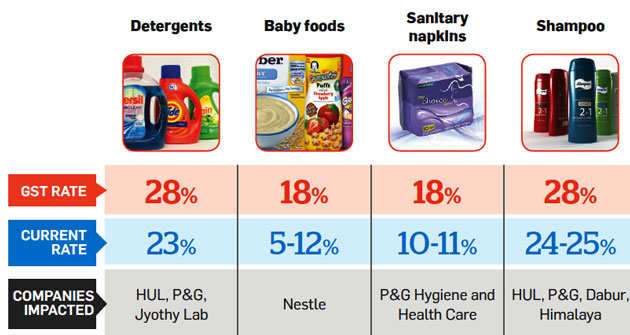
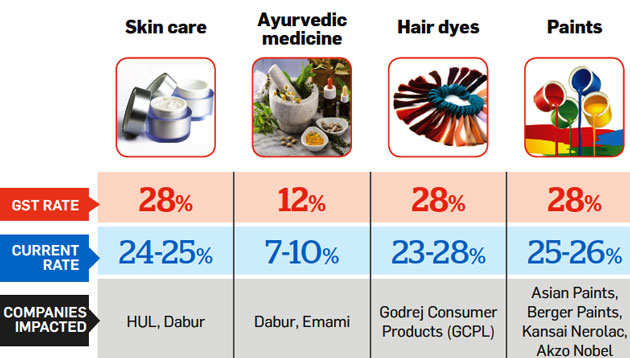
Surprisingly, some of the widely consumed products have been placed under the highest tax slab of 28%—slightly higher than the rate levied earlier. “Higher tax rate in paints and possibly baby food will marginally impact Asian Paints and Nestle,” says the Axis Capital report. Higher tax rate for detergents and shampoo is a real dampener since these are daily-use, mass consumption items. Manufacturers will have to pass on the higher tax incidence to consumers in the form of higher prices of these goods.

However, it will not have much impact on the sale volumes, say analysts. Most of the items belonging to the premium category have been put under the highest tax slab of 28%. These include health supplements, skin care, aerated drinks, liquid soap, among other goods. But this is not going to have a particularly negative impact on manufacturers as they had been paying similar taxes earlier. The increase, in some cases, is only marginal.

However, the firms who were focusing on premiumisation of their product mix to drive profitability, could be hurt because of the higher taxes. These firms may have to rethink strategy and realign their portfolio. Ayurvedic products—a segment that is seeing increased focus from leading FMCG players—are to be taxed at 12%, slightly higher than the prevailing rate. This may hurt Dabur, which has a wide portfolio of ayurvedic products. Emami too could come under pressure. Ayurvedic players were expecting the tax rate to go down, given the government’s thrust on popularising traditional Indian medicine.

For most other FMCG majors, the GST rate structure is likely to be neutral or marginally positive, as their broad portfolios would see a mixed impact. In case of HUL, for instance, tax incidence has reduced for soap, toothpaste and tea, but increased for detergent, shampoo and skin care. For Godrej Consumer Products, lower tax incidence on soaps and insecticides is a positive, but higher tax rate for hair dye is a negative.

Source : http://economictimes.indiatimes.com/wealth/personal-finance-news/how-gst-impacts-fmcg-firms/articleshow/58868546.cms


How will GST impact state revenues?

How will GST impact state revenues?

state revenues

The GST will be implemented soon. This is a value-added tax (VAT) system that subsumes a number of central and state taxes. How would GST impact state governments? We look at the finances of 12 large states.

Does VAT improve revenue growth?

In a VAT system, each person in the value chain gets input credit on the tax paid by the previous persons. This acts as an incentive to ensure that the previous person has paid tax. When VAT was introduced for sales tax a decade ago, states saw an increase in the tax growth rate (though there could be other factors such as higher nominal gross domestic product growth). While excise, service tax and sales tax allow for tax credits within their silos, GST integrates these and enables tax credit across these taxes.

Less than 46% of states’ own tax revenue to be subsumed into GST

GST subsumes various taxes levied by states, including sales tax, entertainment tax and entry tax, except the revenue from excise on alcohol and sale of alcohol and petroleum products. We do not have disaggregated data on sales tax on alcohol.

Tax revenue to be subsumed (plus revenue on sale of alcohol) was 46% of states’ own tax revenue in 2015-16. Excluding sales tax on alcohol, which will continue to be taxed separately by states, revenue subsumed would be lower than 46% of own tax revenue.

Few states seem to benefit from the compensation

States will be compensated for any shortfall in revenue collection due to implementation of GST in the rst ve years. The baseline is assumed to be a growth of 14% compounded from 2015-16. On average, the growth in revenue from the subsumed taxes for these states grew 14% between 2010-11 and 2015-16. This is not adjusted for sales tax on alcohol and petroleum products. However, as GST subsumes some central taxes too (such as excise and service tax) and states get half the share, there may be a difference in the tax base and tax growth.


Source : http://www.livemint.com/Politics/WsrPmJyRGTTWeuUhxEDuoO/How-will-GST-impact-state-revenues.html