Browsed by
Tag: UGST

Central Government Released Rs 1.65 Lakh Crore As GST Compensation To States In FY20

Central Government Released Rs 1.65 Lakh Crore As GST Compensation To States In FY20

The central government’s payout to states as compensation towards goods and services tax for the year ended March more than doubled over the last year as a result of slowing economic activity.

The compensation to states was Rs 1,65,302 crore, the Ministry of Finance said in a statement, adding the GST compensation cess, collected by the Centre, stood at Rs 95,444 crore. In 2018-19, the GST cess collected and compensation released to states were Rs 95,081 crore and Rs 69,275 crore, respectively.

The virus outbreak and the world’s most stringent lockdown lasting over more than two months aggravated an already-slowing economy by obliterating consumption—which nearly contributes 60% to the economy. As a result, India’s economy is widely expected to witness its first contraction in nearly four decades.

The central government compensates states bi-monthly as they lost powers to levy taxes such as value added tax with the rollout of GST. The compensation is guaranteed for five years, and is calculated at a growth rate of 14% keeping 2015-16 as the base year. With declining GST collections last year following a demand-led slowdown, the government had stopped releasing compensation bi-monthly due to inadequate collections from GST compensation cess that’s levied on sin or demerit goods.

Since the cess collected was about Rs 70,000 crore less than the requirement to compensate states, the amount collected as excess in 2017-18 and 2018-19 of about Rs 47,271 crore was used for the same. Besides, Rs 33,412 crore—that was transferred to Consolidated Fund of India—as balance IGST in 2017-18, was also utilised to compensate states, the statement said.

The amount of compensation to be given to the states is going to increase substantially this year, Rajat Bose, a partner at Shardul Amarchand Mangaldas & Co., said. That, he said, would be on account of muted GST collections as the Covid-19 pandemic has impacted consumption.

The government may have to resort to market borrowing to fulfill its commitment towards compensating states for losses due to GST, Bose told BloombergQuint.

The government is exploring various options to adequately compensate states that involve raising money from the markets with a guarantee from the central government or by extending compensation levy beyond five years and continuing to compensate states with the collections.

No Compensation For Five States
Maharashtra received the highest compensation of Rs 19,233 crore in 2019-20 followed by Karnataka that got Rs 18,628 crore, the statement said. Meghalaya received the lowest compensation of Rs 157 crore. States such as Manipur, Mizoram, Sikkim, Nagaland and Arunachal Pradesh reported surplus collection and didn’t need compensation from the Centre.

Source: Bloomberg-Quint

XaTTaX is Best GST Software, Simplify your Financial matters with GST eFiling Software for Return Filing & GST Billing Software in India.

  • Automate Invoicing and get Paid Faster
  • Integration with all popular accounting software
  • Manage your GST and E-WayBill Software anytime anywhere using multiple devices

Get Our GST Software DEMO and E-WAY BILL DEMO for FREE

No GST on everyday items like milk and meat

No GST on everyday items like milk and meat

Bollywood actor Rahul Bose tweeted how a Chandigarh-based five-star hotel billed him a staggering ₹442, including GST (goods and services tax), for just two bananas. The GST amount was ₹67.50—a 9% central GST of ₹33.75 and a 9% Union Territory GST of ₹33.75. The news seem to have fizzled out, but as a consumer, it’s important to know what’s the right GST amount you need to pay, and which items are exempt from GST altogether. Here are a few everyday items, across three categories, on which you don’t need to pay GST.

Food items: There is no GST on fresh or pasteurized milk, butter milk, curd, chena or paneer, and non-vegetarian items like eggs, chicken, fresh meat, and fresh or chilled fish. Fruits, vegetables, as well as unit container-packed frozen branded vegetables (uncooked or steamed) are also exempt.

Other items on this list include natural honey, hulled cereal grains like barley, wheat, oat and so on. Palmyra jaggery, all types of salt, flours like gram or pea flour, coconut, fresh or dried, whether or not shelled or peeled, all kinds of whole spices like seeds of anise, fennel, coriander, cumin or caraway, are exempt. Even items like papad, except when served for consumption, bread (branded or otherwise), and pizza bread are exempt. Water (other than aerated, mineral, purified, distilled, medicinal, ionic, battery, de-mineralized and water sold in sealed containers) have no GST.

Personal items: Several personal items too feature on the zero GST list. For instance, sanitary pads, kajal (other than kajal pencil sticks), glass and plastic bangles, hearing aids, slates, pencils, chalk sticks, passenger bags, bindi, and all types of contraceptives, including condoms.

Miscellaneous items: These mostly include stationery items and items bought from the government. For instance, picture, colouring and drawing books for children, music books, manuscripts, postal items like envelope and post cards sold by the government, newspapers, journals and periodicals, whether illustrated or containing advertising material. Maps and hydro graphic or similar charts of all kinds, including atlases, wall maps, topographical plans and globes, that are printed are also included. Cheques, loose or in a book form, printed books, including Braille books, judicial and non-judicial stamp papers, court fee stamps when sold by government treasuries or vendors authorized by the government, and rupee notes when sold to the Reserve Bank of India are part of the list.

Religious routine ritual items like rudraksha attract no GST. Even items like earthen pots, clay lamps are not in the GST list. Medical items like blood from blood banks attract no GST either.

Remember that some items may attract zero GST only if they are not packaged.

Source: LiveMint
Written By: Bindisha Sarang

XaTTaX is Best GST Software, Simplify your Financial matters with GST eFiling Software for Return Filing & GST Billing Software in India.

  • Automate Invoicing and get Paid Faster
  • Integration with all popular accounting software
  • Manage your GST and E-WayBill Software anytime anywhere using multiple devices

Get Our GST Software DEMO and E-WAY BILL DEMO for FREE

GST collection grows 5.8% in July to ₹1.02 trillion

GST collection grows 5.8% in July to ₹1.02 trillion

Central and state governments have collected Rs. 1,02,083 crore from Goods and Services Tax (GST) in July, 5.8% more than what they mopped up in the same month a year ago, an official statement said here.

This is the third time the combined central and state GST receipts crosses ₹1 trillion mark so far this fiscal. The union government is bound to compensate states for any shortfall in their revenue collection below an agreed 14% annual growth every year in the first five years of GST regime. Tax collected in July pertain to the transactions in June. After showing a 10% annual growth in April GST receipts, collections remained rangebound between 6.6 and 5.8% in subsequent months.

The statement said the union government collected ₹17,912 crore, while states collected ₹25,008 crore. Receipts from integrated GST (IGST) on inter-state sales stood at ₹50,612 crore and from GST cess at ₹8,551 crore. On account of the revenue shortfall in FY19 and the growth rate remaining below 14% so far in FY20, the central government’s requirement to compensate states continues and raises questions about states revenue position after the first five years of GST if the current trend continues. Central and states collected and average RS 93,114 crore a month last fiscal against a ₹1 trillion combined monthly target.

The GST shortfall could make the union government more dependent on cesses and surcharges on various taxes to find resources for compensating states for their revenue shortfall.

The Controller General of Accounts (CGA), the government’s internal auditor, said on Wednesday the central government’s gross tax revenue in the June quarter grew at a slow pace of 2.7% to ₹1.86 trillion from the year ago period. (ends)

Ease Your GST Retrun Filing & Invoice with XaTTaX- GST Software

Source: Live-Mint.
One year of GST: Modi government lists 5 key benefits of landmark indirect tax reform

One year of GST: Modi government lists 5 key benefits of landmark indirect tax reform

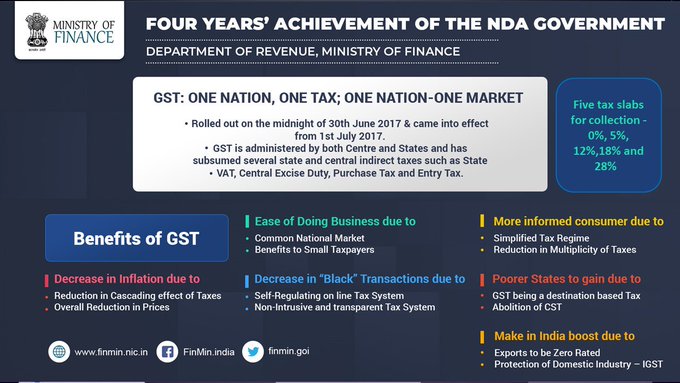
It’s been nearly one year since the new indirect tax regime came into existence on the 30th of June 2017, as GST: ‘One nation, One tax,’ in order to simplify the taxation on goods and services. Administered by both the center and states, Goods and Services Tax has subsumed several state and central indirect taxes such as State VAT, Central Excise Duty, Purchase Tax and Entry Tax. Positioned as one of the major structural reforms of the Narendra Modi-led government in the last four years since they came to power, the revenue department has released key benefits under the new regime. We take a closer look at the five key benefits.

Ease of doing business

According to the Revenue Department, GST has provided benefits to the small-taxpayers. Notably, under the GST, tax payers with an aggregate turnover in a financial year up to Rs.10 lakhs are exempt from tax. (Aggregate turnover shall include the aggregate value of all taxable and non-taxable supplies, exempt supplies and exports of goods and/or services and exclude taxes viz. GST.). Further, the GST has helped to improve the ease of doing business due to common national market.

Decrease in inflation

According to the government, GST has led to a decrease in inflation due to the reduction in cascading effect of taxes and the overall reduction in prices. With an intent to curtail the inflation, the Government has taken various measures under the new regime including finalization of rates which are aligned to existing rate structure for most items and introducing an anti-profiteering clause in the GST law.

GST

A decrease in black transactions

Due to the ‘non-intrusive’ and transparent tax system, the GST has led to a reduction in black transactions, according to the Ministry of Finance. Notably, Goods and Service Tax is a self-regulating online tax system.

Boost to Make in India

The government’s initiative of Make In India has also received a big boost under GST, as IGST provides protection to the domestic industry. Further, certain taxable supplies are taxed at the rate of 0% rather than at the standard rate of 15%, in case of export-related businesses.

More informed customers

The ministry of finance states that goods & service tax has led to more informed consumers due to the simplified tax regime, and the reduction in the multiplicity of taxes.

Source: Financial Express