
GST helped you save Rs 320 per month: Analysis
You are saving up to Rs 320 every month on your common-used daily item including soaps, food items, cosmetics after implementation of GST since July 2017, a finance ministry source said citing an analysis.
According to an analysis of household expenditure on before and after implementation of GST, the tax rates have come down on 83 common used items including food and beverages as well as daily use goods like hair oil, toothpaste, soap, washing powder, and footwear.
As per analysis, a household would be saving Rs 320 every month on their monthly spend of Rs 8,400 on 10 goods — cereals, edible oil, sugar, chocolates, namkeen and sweets, cosmetics and toiletries, washing powder, tiles, furniture and coir products, and other household products, the PTI quoted a source referring to the expenditure analysis.
In comparison, the analysis highlights that the GST on the Rs 8,400 spending comes out to be Rs 510, which is less than Rs 830 charged before the implementation of GST, resulting into a saving of Rs 320 every month.
As per the analysis, an array of items like spices, wheat, rice, nutrition drinks like Horlicks/Bournvita, pasta, idli dosa batter, mineral water, milk powder, curd, and buttermilk are currently taxed at a lesser rate under the GST than previously.
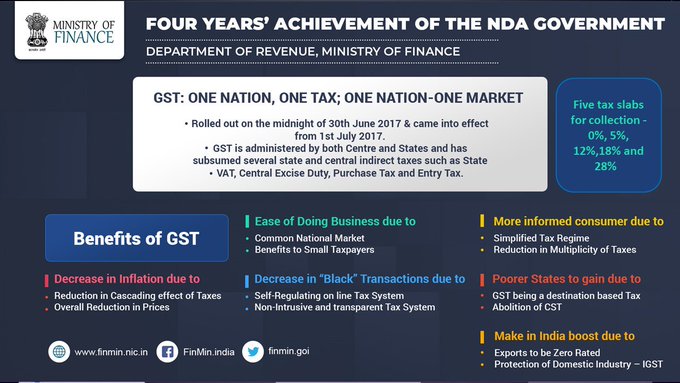
In the old tax system before GST, the central government would levy excise duty when a good is produced in a factory and the state governments would charge VAT on top of this. This meant that consumer not just paid VAT on the basic price of the good but also on the excise duty charged by the center.
With the introduction of GST, that pattern was eliminated. The GST is levied at the consumption end or when the final consumer buys the product or service.
After the introduction of GST in many other countries, it was seen that the inflation rose post-GST rollout due to change in tax structures, but the trend has not seen in the Indian case as the GST council has revised rates on numerous occasions.
wheat and rice have been exempt from tax under the GST as against 2.50-2.75 percent tax incidence previously. Similarly, tax on milk power is down to 5 percent from the previous 6 percent.
Similarly, sugar confectionery is taxed at 18 percent post-GST, as against 21 percent in the earlier indirect tax regime.
The tax rate on sugar and edible oil has come down to 5 percent under the new tax system, from 6 percent earlier. Also, namkeens and sweets are now taxed at 5 percent, as against 12 per cent/7 percent earlier.
Also, the tax rate on washing powder and tiles has come down to 18 percent from 28 percent earlier.
In the case of furniture, 5/18 percent GST is applicable on various kinds of products, while in the earlier regime the tax rate was 12/28 percent.
XaTTaX: Your automated E-Way bill compliance is just a click away!
Source: Economic Times.India


 with the component on value added tax and replace it with GST in the Class X mathematics syllabus.